
Mondial/aclaros enrich Financial Reporting in Mid-Market ERP

Accelerate Financial Reporting for Mid Markets BEDFORD, New Hampshire, June 15, 2023. Mondial Software and Aclaros partnered to advance financial reporting for mid-market companies, including SAP Business One users. The collaboration supports Mondial’s global financial reporting platform for multinational companies requiring unified management, group, and statutory reporting. The Partnership Value “Mondial’s product offers great value for companies who need consolidations and complex financial reporting”, said L. Bertus Jacobs, Managing Partner of aclaros. “Mondial meets the needs of businesses operating multiple entities or in multiple countries who need consolidated financials. It integrates seamlessly with SAP Business One and various ERPs, easing multi-currency conversion and spreadsheet consolidation.”” “We’re delighted to be partnering with Aclaros, an SAP Platinum Partner and one of the leading SAP Business One Partners serving small and mid-sized businesses globally”, said Mondial’s CEO Mark Richardson. “Aclaros has a long track-record working with organizations to help them implement and get the most out of their ERP solutions – wherever they do business. Their understanding of the complex financial reporting and compliance needs of global companies makes them an excellent match for our firm.” About Mondial Software Mondial Software is a global provider of cloud-based tools for multi-ERP financial reporting and consolidations. Founded by experienced accounting professionals with global ERP backgrounds, Mondial serves a worldwide customer base. For more information, visit http://www.https://mondialsoftwareinc.com. About aclaros Aclaros is a leading systems integration and management consulting company with offices in Canada, the United States. Its experienced team enables customers to realize their vision by leveraging the world’s leading on-premises and cloud-based business applications. It specializes in various SAP Business One versions and modules, serving diverse industries like distribution, manufacturing, retail, and services. Aclaros is a member of the United Vars alliance and an SAP Platinum Partner. For more information, visit https://aclaros.com/. Your next steps… 💡Click here to reduce time spent on period-end reporting 🔋Click here if you wish to solve 25+ Spreadsheet reporting issues 🔆 Click here to improve the accuracy and usability of generated reports 💯 Click here to decrease risk by providing on-demand access to the transaction detail behind every reported balance ☎️ Book a free, no-obligation walkthrough with Mondial to see how we can help you in financial reporting and consolidations just like one of our successful clients.
Takeaways SAP Partner Summit for Small to Midsize Enterprise
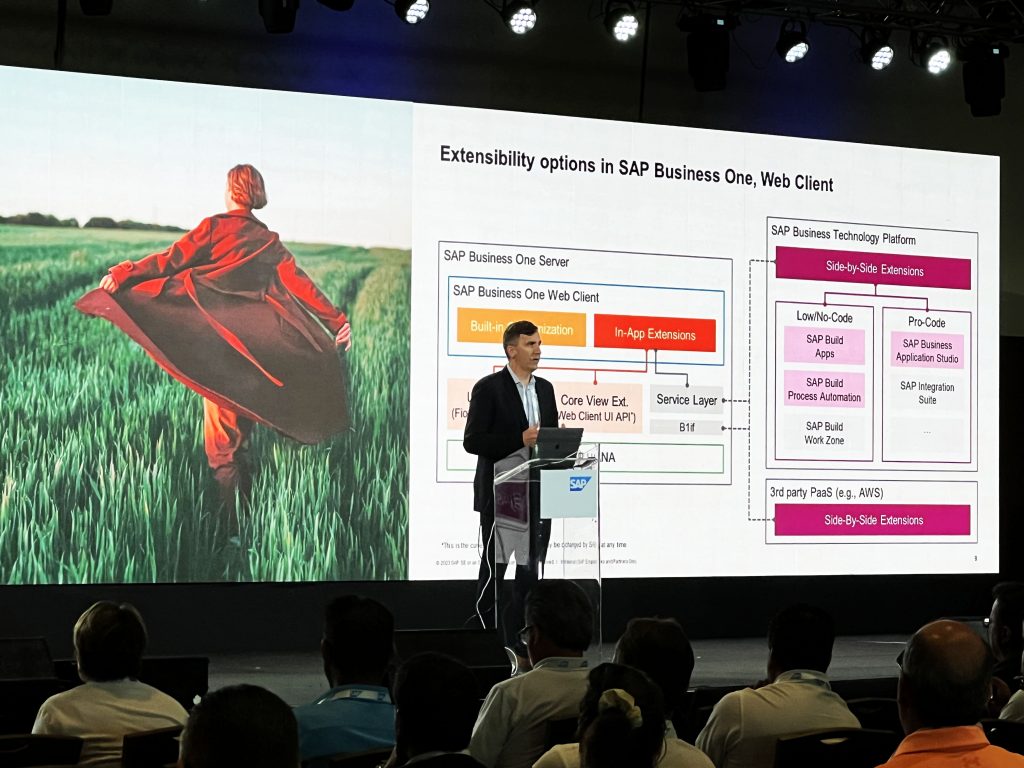
Key Takeaways and Learnings: Mondial Software participated in the recent 2023 SAP Partner Partner Summit for Small to Mid-Sized Enterprise (SME). At the event, we engaged with SAP, learning their vision, and shared Mondial’s developments.” In 2023, SAP Partner Summit was esteemed, a must-attend for SAP’s SME-focused partners delivering solutions. The summit delved into SAP S/4 HANA Public Cloud, Business One, and Business ByDesign advancements. Furthermore, it facilitated discussions on harnessing the power of the SAP Business Technology Platform to accelerate cloud innovations. The SAP Partner Summit provided Mondial with several key takeaways and learnings: Continuous Innovation: To thrive in a rapidly evolving business landscape, businesses must embrace a culture of continuous innovation. SAP’s solutions offer the necessary tools and platforms to foster innovation and drive growth. Cloud Adoption: The cloud has become an essential enabler for businesses seeking scalability, agility, and cost-efficiency. Utilizing SAP S/4 HANA Public Cloud and Business One empowers Mondial’s clients with real-time insights for efficiency. Collaboration and Networking: At the summit, emphasis on collaboration within the SAP ecosystem fosters innovation and valuable partnerships for SAP B1 users. Customer-Centric Approach: SAP’s focus on tailoring the summit agenda to each role underscores the importance of a customer-centric approach. Mondial aligns solutions to meet unique client needs, ensuring success and satisfaction. Relevance Through active participation in the SAP Partner Summit, Mondial and other partners stayed updated on trends, enhancing expertise. This allowed us to showcase our integrated solutions within the SAP B1 environment. Additionally, the event served as a collaborative platform, fostering interactions, networking, and strengthening partnerships within the SAP ecosystem. Moreover, SAP’s commitment to SAP Business One as a primary web client aligns with Mondial’s vision. With the ability to launch Mondial directly from the SAP Business One Web Client, seamless integration with various ERP products, both SAP and non-SAP, is now feasible. Moving forwards: The SME SAP Partner Summit transformed Mondial Software and other businesses toward growth, innovation, and sustainability. Summit participation granted Mondial insights into ERP advancements, cloud innovations, and SAP’s future vision. The event affirmed our dedication to enabling businesses with 100x faster, accurate financial reporting and consolidation. Your next steps 💡Click here to reduce time spent on period-end reporting 🔋Click here if you wish to solve 25+ Spreadsheet reporting issues 🔆 Click here to improve the accuracy and usability of generated reports 💯 Click here to decrease risk by providing on-demand access to the transaction detail behind every reported balance ☎️ Book a free, no-obligation walkthrough with Mondial to see how we can help you in financial reporting and consolidations just like one of our successful clients.
How to Fix Common Charts of Accounts Challenges in Financial Reporting

The Charts of Accounts Mystery. The charts of accounts (COA) is a fundamental tool used in financial reporting, additionally serving as a vital component of an organization’s accounting system. It provides the necessary structure and organization for the systematic classification and recording of financial transactions. In essence, the COA acts as a roadmap, guiding finance and accounting teams in categorizing and classifying these transactions into relevant accounts. This article gives us rundown on how to fix common charts of accounts challenges. Each account within the COA represents a unique element of an organization’s financial position, such as assets, liabilities, revenues, and expenses. By assigning specific codes or numbers to these accounts, the COA consequently enables the efficient tracking and analysis of financial data. It serves as a standardized framework that facilitates the preparation of financial statements, including the balance sheet, income statement, and cash flow statement. Your COA, why it’s important? The significance of the COA in financial reporting cannot be overstated. It provides a common language for finance professionals, also ensuring consistent and accurate recording and reporting of financial information. The COA facilitates the aggregation of financial data, enabling stakeholders to gain insights into an organization’s financial performance, make informed decisions, and comply with regulatory requirements. Furthermore, the COA allows for the customization and tailoring of financial reports to meet specific reporting needs. It enables the segmentation of financial information by departments, cost centers, geographical locations, or any other relevant categories, providing management with valuable insights for strategic decision-making. Oftentimes, Finance and Accounting Teams wrestle with the COA Despite its critical role, finance and accounting teams often encounter challenges when working with the COA. These challenges can arise from issues such as inconsistent account structures, insufficient granularity, complex account numbering schemes, inadequate account descriptions, and a lack of alignment with business operations. Addressing these challenges is essential to ensure accurate and reliable financial reporting. Above all, to streamline processes, and enhance the effectiveness of finance and accounting teams. Inconsistent account structure within the Chart of Accounts (COA) A common challenge in financial reporting is an inconsistent account structure within the charts of accounts (COA). This occurs when there is a lack of standardized organization, resulting in confusion and discrepancies when categorizing financial transactions. Inconsistent account structures can manifest in various ways, such as varying levels of account granularity, conflicting naming conventions, or different hierarchies across departments or business units. For example, imagine a multinational corporation with multiple subsidiaries and divisions. Each division may have developed its own account structure independently, resulting in differences in the numbering system, account descriptions, and hierarchical relationships. One division might categorize expenses by cost centers, while another division uses a different method based on product lines. All things considered, inconsistency creates challenges when trying to consolidate financial data, analyze trends, or compare performance across divisions. It leads to confusion, delays, and potential errors in financial reporting. Impact worth taking a look at… The impact of an inconsistent account structure can be significant. Albeit it hampers the ability to generate accurate and meaningful financial reports, as the data from different departments or divisions cannot be easily aggregated or compared. It makes it difficult to identify and track specific transactions or understand their context within the organization’s operations. Inconsistent account structures also increase the risk of misclassification and misinterpretation of financial data, potentially leading to errors in financial statements and regulatory compliance. How to Fix Inconsistent account structure within the charts of accounts (COA)? Start by conducting a comprehensive review of the COA’s structure and hierarchy. Engage key stakeholders, including finance, accounting, and operational teams, to ensure alignment with business operations. Establish clear guidelines for account numbering, naming conventions, and hierarchical structure. Regularly communicate and educate the finance team on the COA structure to maintain consistency. Implement periodic reviews and updates to accommodate any changes in the organization’s structure or reporting requirements after that. Lack of Detailed Granularity Insufficient detail within the charts of accounts (COA) can present significant challenges for finance and accounting teams when analyzing specific transactions and generating accurate financial reports. When the COA lacks the necessary granularity, it becomes difficult to gain meaningful insights from the financial data, hindering decision-making processes and compromising the reliability of financial reporting. Insufficient detail in the COA can manifest in various ways. For example, the COA may lack specific accounts to capture transaction details that are crucial for analysis or reporting purposes. This could include accounts for specific product lines, geographical regions, cost centers, or other relevant categories. Without these detailed accounts, it becomes challenging to track and analyze the financial performance of different segments of the business. Consider an example of a retail company with multiple store locations. If the COA does not include separate accounts for each store, the company would struggle to evaluate the individual financial performance of each location. This lack of granularity both would impede the identification of underperforming stores or the assessment of the impact of regional factors on profitability. Far reaching consequences The impact of insufficient detail within the COA can be far-reaching. It hampers the ability to perform in-depth analysis, hindering the identification of trends, patterns, and outliers within the financial data. This, in turn, limits the effectiveness of decision-making processes and may lead to missed opportunities or ineffective resource allocation. Additionally, it can result in the misrepresentation of financial information in reports, potentially leading to inaccuracies, misleading insights, and regulatory compliance issues. How to fix lack of detailed granularity in your COA? Analyze the reporting requirements and business operations to identify areas where additional granularity is needed. Collaborate with stakeholders to not only understand their information needs but also to incorporate those requirements into the COA. Consider expanding account codes to capture more specific transaction details. Regularly review and update the COA to ensure it aligns with evolving reporting needs and industry best practices. Overcomplicated Account Numbering Overcomplicated account numbering within the charts of accounts (COA) can significantly impede efficient financial reporting. This challenge arises when the